Canetoad.co.uk
Home Automation (HA)
HA Platform
The core of our HA installation is Misterhouse. For those not familiar with Misterhouse it is a mature, comprehensive and extensible solution written largely in Perl.
This has been the heart of our HA for more than 25 years. Lots of investment of time and effort in writing custom code for telemetry, scheduling and control of our living environment!
There is still an active global user community and helpful mailing list etc. The active development code is now on github.
Of course, much has changed over this length of time in the HA and technology market overall. This is especially true in terms of end devices, control protocols and back-end integrations.
When we started out there was really only X10 for both mains device control and X10 RF for motion sensors. We now only use X10 RF for legacy (but still available) motion sensors and door/window sensors. All mains devices are now using ZWave or MQTT (Tasmota). Many newer motion and door sensors are also Zwave/Zigbee.
In line with many other people we’ve introduced an interface layer between MH and the end devices using Home Assistant. There is much more active development on that platform in terms of new device support. Misterhouse is still used as the ‘intelligence’ layer given the significant quantity of user code.
The Zwave layer uses a mixture of core hubs including a legacy Vera Security, Hubitat Pro and Raspberry Pi based Zwave.me which all talk directly to the Home Assistant layer. Previously MH used a mixture of modules written in-house for Vera and Hubitat and the native MH native raZberry module.
Over recent years MQTT/Tasmota has also found a place in mains control here, again originally using the MH native MQTT code, but now via Home Assistant. The migration from MH direct to the Home Assistant interface layer has been surprisingly painless (so far).
We also use a number of legacy RFXCom receivers with Heyu on Linux and XPL-Perl on Raspberry Pi as well as newer RFXtrx receivers using Node Red on Raspberry Pi. These interface to other RF devices such as power monitors, Oregon Weather, Temperature and Humidity sensors.
We also run a raspberry Pi based weather station and a number of Pi Air Quality and Environmental sensors. Some Dallas 1-wire temperature sensors are still in use as well.
This data is used in-home and also published on a number of citizen science project pages. Our front window also sports a pair of LED Array signs carrying current weather conditions, Air Quality and Global CO2 levels.
HA Platform
The core of our HA installation is Misterhouse. For those not familiar with Misterhouse it is a mature, comprehensive and extensible solution written largely in Perl.
This has been the heart of our HA for more than 25 years. Lots of investment of time and effort in writing custom code for telemetry, scheduling and control of our living environment!
There is still an active global user community and helpful mailing list etc. The active development code is now on github.
Of course, much has changed over this length of time in the HA and technology market overall. This is especially true in terms of end devices, control protocols and back-end integrations.
When we started out there was really only X10 for both mains device control and X10 RF for motion sensors. We now only use X10 RF for legacy (but still available) motion sensors and door/window sensors. All mains devices are now using ZWave or MQTT (Tasmota). Many newer motion and door sensors are also Zwave/Zigbee.
In line with many other people we’ve introduced an interface layer between MH and the end devices using Home Assistant. There is much more active development on that platform in terms of new device support. Misterhouse is still used as the ‘intelligence’ layer given the significant quantity of user code.
The Zwave layer uses a mixture of core hubs including a legacy Vera Security, Hubitat Pro and Raspberry Pi based Zwave.me which all talk directly to the Home Assistant layer. Previously MH used a mixture of modules written in-house for Vera and Hubitat and the native MH native raZberry module.
Over recent years MQTT/Tasmota has also found a place in mains control here, again originally using the MH native MQTT code, but now via Home Assistant. The migration from MH direct to the Home Assistant interface layer has been surprisingly painless (so far).
We also use a number of legacy RFXCom receivers with Heyu on Linux and XPL-Perl on Raspberry Pi as well as newer RFXtrx receivers using Node Red on Raspberry Pi. These interface to other RF devices such as power monitors, Oregon Weather, Temperature and Humidity sensors.
We also run a raspberry Pi based weather station and a number of Pi Air Quality and Environmental sensors. Some Dallas 1-wire temperature sensors are still in use as well.
This data is used in-home and also published on a number of citizen science project pages. Our front window also sports a pair of LED Array signs carrying current weather conditions, Air Quality and Global CO2 levels.
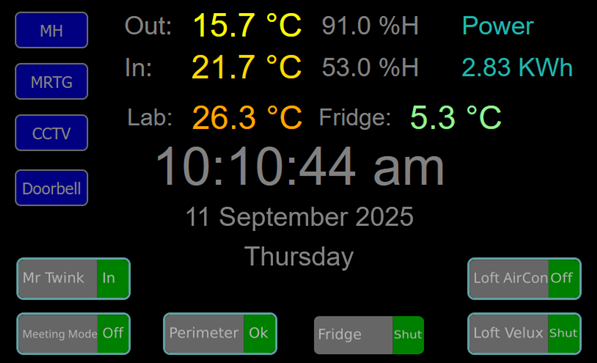
Consoles around the house are based on Raspberry Pi 3b+ with touchscreens and speakers for audio announcements. Mr Twink is our cat.
HA Infrastructure
Copyright © 2025 info@canetoad.co.uk